
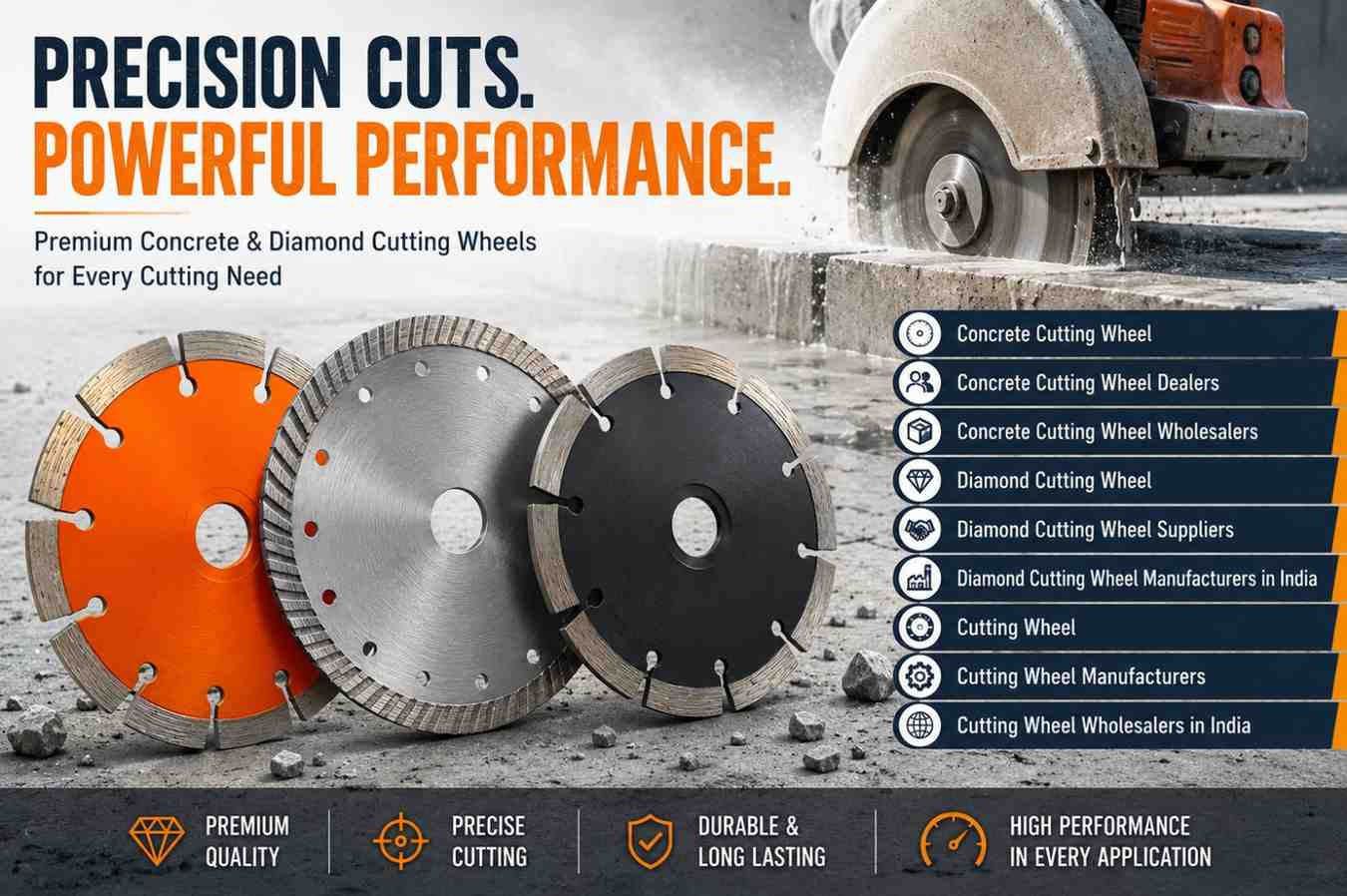
A failed Concrete Cutting Wheel does not usually fail in the warehouse. It fails halfway through a pour-cut job at 2:15 PM, with operators waiting, coolant running, and a contractor already behind schedule. That's when procurement teams realise the cheapest quotation was never the cheapest option.
Across infrastructure, fabrication, stone processing, and heavy construction, buyers are moving toward established Diamond Cutting Wheel Suppliers because downtime now costs more than tooling. A 2025 Indian construction equipment report estimated that idle machine time can raise project costs by 17% to 22% on large civil jobs. And yet, many buyers still compare wheels only by unit price.
The Spec Detail Most Buyers Skip Before Ordering a Cutting Wheel
Not all Cutting Wheel products are built for the same load cycle, RPM range, or material density. Buyers who treat them as interchangeable usually learn the expensive way.
Bond Type Changes Everything
A premium Diamond Cutting Wheel depends heavily on bond formulation. Soft bonds cut aggressively on hard materials like cured concrete and granite, while harder bonds last longer on abrasive materials such as asphalt.
Most catalogues barely explain this.
Which means buyers often end up using the wrong wheel for the application and blaming the supplier later. The wheel was not defective. The specification was wrong from the start.
Segment Height Impacts Real Cutting Life
Industrial-grade wheels typically use segment heights between 10 mm and 15 mm. That difference matters. A 15 mm segment can extend usable life by nearly 20% on continuous heavy-duty applications compared to thinner segments.
Cheap suppliers rarely disclose segment composition consistency across batches.
That omission matters more than glossy packaging.
Cooling Method Is Not a Minor Detail
Wet cutting wheels reduce dust and maintain lower operating temperatures. Dry cutting variants offer mobility but generate significantly higher heat loads. OSHA studies globally have shown silica dust exposure remains a major issue during concrete cutting operations.
And yet, some suppliers still push dry-use wheels for every application because stocking fewer SKUs is easier for them operationally.
RPM Compatibility Gets Ignored Too Often
Nobody tells you how many premature wheel failures come from mismatched spindle speeds.
A wheel rated below machine RPM is not just inefficient. It becomes a safety risk. Reputable Cutting Wheel Manufacturers provide tested RPM ranges, arbor specifications, and machine compatibility sheets upfront.
The Overlooked Factor: Core Stability
Here’s the detail experienced procurement managers check immediately: core flatness tolerance.
Low-grade steel cores warp under continuous thermal load. Once wobbling starts, cut precision drops fast and operator fatigue increases. On bridge-cutting and precast concrete work, that directly affects output quality.
One bad batch can wipe out a week's margin.
Five Supplier Checks That Separate Reliable Vendors From Trading Companies
1. Ask About Batch Consistency, Not Just Certification
-
Good answer: “We test every production batch for balance, bond retention, and segment adhesion.”
-
Bad answer: “Our products follow standard quality norms.”
That vague sentence usually means they outsource production and cannot control consistency.
2. Check If the Supplier Understands Application Differences
-
Good answer: recommendations change based on reinforced concrete, asphalt, marble, or stone.
-
Bad answer: one wheel suggested for every material category.
A supplier selling one universal wheel for everything is solving inventory problems, not your cutting problems.
3. Verify Delivery Capability During Peak Demand
-
Good answer: realistic lead times with stocking details.
-
Bad answer: “Delivery depends on factory situation.”
Infrastructure demand spikes between October and March across India. Experienced Diamond Cutting Wheel Suppliers prepare inventory before that cycle starts.
4. Ask About Failure Handling Policy
-
Good answer: documented replacement or inspection protocol.
-
Bad answer: “We handle complaints case by case.”
That sentence sounds flexible until a shipment issue appears after installation.
5. Request Technical Data Sheets Before Pricing Discussion
-
Good answer: RPM, bond grade, segment specs, application range.
-
Bad answer: only price lists and catalogue images.
Most buyers spend more time negotiating ₹8 per wheel than checking if the specification actually matches machine load conditions.
Why Premium Cutting Wheels Protect Margins Better Than Cheap Imports
Reduced Downtime During Continuous Operations
Industrial cutting lines running 8 to 12 hours daily cannot afford inconsistent wheel wear. Premium Concrete Cutting Wheel products maintain more stable cutting depth and speed over longer production cycles.
That reduces machine stoppages.
Lower Material Wastage
A balanced Diamond Cutting Wheel produces cleaner cuts with fewer edge fractures. On tile, stone, and engineered slab applications, cleaner edges directly reduce rejection rates.
Even a 3% reduction in breakage matters at scale.
Better Operator Safety
According to industrial safety studies, wheel imbalance and overheating remain leading causes of abrasive wheel failures globally. Higher-grade steel cores and tested bonding systems reduce that risk substantially.
More Predictable Procurement Planning
Reliable Cutting Wheel Manufacturers maintain repeatable specifications across orders. Procurement teams can forecast performance more accurately instead of adjusting constantly for inconsistent product life.
Stronger Dealer Reputation
For distributors and Concrete Cutting Wheel Dealers, poor wheel performance damages their credibility faster than pricing disputes. Contractors remember failures vividly.
Nobody remembers saving ₹14 per wheel six months earlier.
Lower Long-Term Operating Cost
Cheap wheels often appear profitable until replacement frequency rises. A premium wheel lasting 28% longer across repeated applications usually delivers better lifecycle cost despite higher initial pricing.
Serious buyers calculate output per cut meter, not just unit cost.
Why India Has Become a Major Hub for Diamond Cutting Wheel Supply
India’s manufacturing ecosystem for abrasive and diamond tooling has expanded sharply since 2018. Export demand from the Middle East, Southeast Asia, and African infrastructure sectors pushed several Diamond Cutting Wheel Manufacturers in India toward tighter production standards.
That shift changed buyer expectations domestically too.
Strong Manufacturing Clusters Matter
States like Gujarat, Maharashtra, and Rajasthan now support integrated supply chains for industrial abrasives, steel cores, bonding compounds, and diamond segment production.
Which means shorter replenishment cycles for buyers across India.
Freight Access Improves Availability
Many Concrete Cutting Wheel Wholesalers now maintain regional distribution in Delhi NCR, Ahmedabad, Chennai, and Kolkata to reduce dispatch delays. This matters because transport damage and humidity exposure can affect improperly packed abrasive products during monsoon logistics.
Export Pressure Improved Standards
Suppliers exporting to 31 countries cannot survive on inconsistent production quality for long. International buyers demand repeatability, documentation, and packaging compliance.
That pressure improved many Indian manufacturers faster than domestic competition did.
Dealer Networks Are Expanding Rapidly
Experienced Concrete Cutting Wheel Dealers increasingly support onsite application guidance instead of just pushing catalogue sales. That is a major shift from the older trading-only model.
And frankly, it was overdue.
Wholesale Buyers Want Fewer Vendors
Large procurement teams increasingly prefer working with fewer, technically capable Cutting Wheel Wholesalers in India rather than juggling multiple low-cost suppliers with uneven quality.
Managing three unreliable vendors is harder than negotiating with one competent manufacturer.
What We’ve Learned Supplying Industrial Buyers at Ultra Touch
At Ultra Touch, we work closely with distributors, infrastructure contractors, and industrial procurement teams across India. We’ve seen projects delayed because the wrong wheel specification was approved simply to hit a short-term purchase target.
We manufacture and supply industrial-grade Diamond Cutting Wheel and Concrete Cutting Wheel products built for demanding applications where consistency matters more than catalogue claims.
We also learned something the hard way in 2022. A packaging adhesive we used for export cartons failed during high-humidity coastal shipments in summer transit. Two distributors reported moisture exposure. We changed the carton sealing process within three weeks and never used that adhesive supplier again.
That is what long-term manufacturing feedback actually looks like.
Most buyers only ask for price and diameter. The experienced ones ask about application load, machine RPM, cooling method, and expected cut depth first.
Those are usually the buyers who stay profitable longer.
If you are sourcing industrial Cutting Wheel products for wholesale, infrastructure, fabrication, or dealer distribution, send us the following:
-
Material application
-
Wheel diameter requirement
-
Arbor size
-
Machine RPM
-
Expected monthly volume
-
Wet or dry cutting preference
We typically respond within one business day.
At Ultra Touch, our MOQ depends on wheel size and specification range, but wholesale and distributor orders generally begin from 500 units upward. Custom branding and export packing options are also available for larger volumes.
Conclusion
The difference between a standard Concrete Cutting Wheel and a premium industrial wheel usually appears after hundreds of cuts, not the first ten. Buyers who understand specification discipline, supplier accountability, and lifecycle cost are the ones building stable procurement systems today. As India's infrastructure and industrial fabrication grow, we can expect both increasing demand and greater expectations for reliable Diamond Cutting Wheel suppliers.
Here is another blog you might be interested in
How to Choose the Right Concrete Cutting Wheel for Heavy-Duty Applications
FAQs
What causes premature Cutting Wheel failure most often?
Incorrect RPM matching, overheating, poor cooling practice, and wrong bond selection account for a large share of failures. In many cases, the wheel itself is not defective.
Are Concrete Cutting Wheel Dealers suitable for bulk infrastructure projects?
Some are. Some are not. Many Concrete Cutting Wheel Dealers operate purely as traders without technical understanding of application loads. Buyers should verify inventory capability and after-sales response before finalising supply agreements.
Why are Indian "Cutting Wheel Manufacturers" gaining export demand?
Many "Cutting Wheel Manufacturers"- in response to the growing export demand from the Middle Eastern and African infrastructure markets- established upgraded production standards. Indian suppliers had the advantage of better process control and low manufacturing costs.
Do Cutting Wheel Wholesalers in India maintain ready stock?
Larger Cutting Wheel Wholesalers in India usually maintain regional inventory for standard sizes. Custom specifications may still require production lead time depending on segment design and quantity.
Are Diamond Cutting Wheel Manufacturers in India comparable to imported brands?
Some absolutely are. Others are still competing only on price. Buyers need to evaluate testing standards, steel core quality, and segment consistency instead of assuming all imported products are automatically superior.

 English
 Arabic
 French
 Spanish
 Portuguese
 Deutsch
 Turkish
 Dutch
Dutch
 Italiano
 Romaian
 Portuguese (Brazil)
 Greek
Greek