
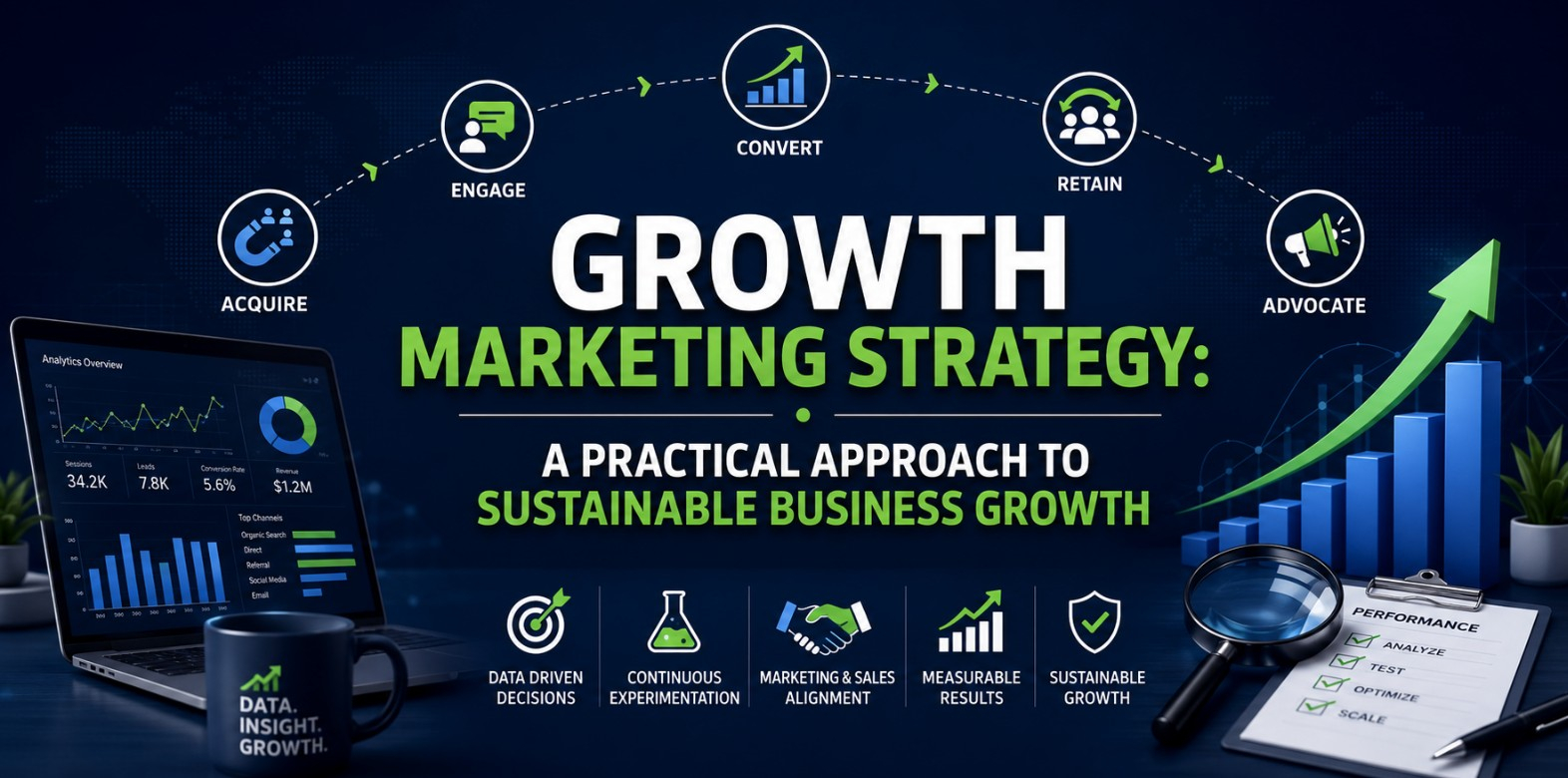
In today's competitive business environment, companies are expected to deliver measurable results while adapting to changing customer expectations. Traditional marketing methods often focus on generating awareness, but modern businesses require a strategy that supports growth across the entire customer journey. This is where a growth marketing strategy becomes essential.
Growth marketing is a data driven approach that combines marketing, customer insights, experimentation, and continuous optimization to improve customer acquisition, engagement, retention, and revenue. Instead of relying on one time campaigns, businesses create repeatable processes that generate sustainable long term growth.
For organisations, where sales cycles are often longer and customer relationships are more valuable, a well planned growth marketing strategy helps maximise every interaction while improving return on investment.
What Is a Growth Marketing Strategy?
A growth marketing strategy is a structured plan that uses customer data, testing, and performance analysis to improve marketing outcomes across every stage of the buyer journey.
Unlike traditional marketing, which often focuses on attracting new leads, growth marketing extends beyond acquisition. It also prioritises customer engagement, conversion, retention, and advocacy.
This approach encourages businesses to test new ideas, evaluate results, and refine campaigns based on real performance metrics instead of assumptions.
Why Growth Marketing Matters for Businesses
Buyers conduct extensive research before making purchasing decisions. They compare multiple vendors, seek expert content, and expect personalized experiences throughout the buying process.
A growth marketing strategy enables organisations to respond effectively to these expectations by creating relevant content, improving lead nurturing, and delivering consistent customer experiences.
Some of the key advantages include:
-
Better quality leads through targeted campaigns.
-
Improved customer retention and loyalty.
-
Higher marketing efficiency based on measurable data.
-
Stronger collaboration between marketing and sales teams.
-
Sustainable revenue growth through continuous optimisation.
Rather than investing heavily in campaigns with uncertain outcomes, businesses can make informed decisions based on customer behaviour and performance insights.
Essential Components of a Growth Marketing Strategy
Define Clear Business Objectives
Every successful strategy begins with well defined goals. These objectives should align with broader business priorities and provide measurable outcomes.
Common objectives may include increasing qualified leads, improving conversion rates, expanding into new markets, or increasing customer lifetime value.
Having clear goals helps marketing teams prioritise activities and evaluate success more effectively.
Understand Your Target Audience
Effective growth marketing starts with understanding customer needs, challenges, and buying behaviour.
Develop detailed buyer personas using customer research, sales feedback, and market analysis. This allows businesses to create personalized messaging that resonates with decision makers at different stages of the buying journey.
The more relevant the messaging, the higher the likelihood of generating meaningful engagement.
Create High Value Content
Content remains one of the most powerful tools in marketing.
Educational articles, industry insights, case studies, reports, webinars, and practical guides help establish credibility while supporting prospects during their decision making process.
Instead of producing content solely for search visibility, businesses should focus on answering customer questions and providing genuine value.
Quality content strengthens trust and positions a company as an industry expert.
Optimise Every Stage of the Customer Journey
Growth marketing looks beyond lead generation.
Businesses should continuously evaluate how prospects move through each stage of the marketing funnel, identifying opportunities to improve engagement and reduce friction.
This includes improving landing pages, simplifying forms, enhancing email communication, and providing personalised follow up experiences.
Small improvements across multiple touchpoints often produce significant long term results.
Use Data to Drive Decisions
Successful growth marketing depends on accurate performance measurement.
Monitor key metrics such as website traffic, lead quality, conversion rates, customer acquisition costs, customer retention, and revenue generated from marketing efforts.
These insights allow marketing teams to identify successful initiatives while quickly adjusting underperforming campaigns.
Data driven decision making reduces uncertainty and supports continuous improvement.
The Importance of Experimentation
One defining characteristic of growth marketing is continuous testing.
Rather than assuming a campaign will succeed, marketers regularly experiment with different headlines, calls to action, email subject lines, landing page layouts, and audience segments.
Each experiment provides valuable insights that improve future campaigns.
Over time, this culture of testing creates a more efficient marketing process and helps businesses remain competitive in changing markets.
Align Marketing and Sales
For organisations, marketing and sales alignment is critical.
Marketing teams generate demand while sales teams convert opportunities into customers. When both departments share common objectives, customer insights, and performance metrics, businesses achieve better results.
Regular communication ensures that marketing attracts qualified prospects while sales teams provide valuable feedback about customer needs and objections.
This collaboration strengthens the entire revenue generation process.
Common Challenges
While growth marketing offers significant advantages, businesses may encounter several obstacles during implementation.
These include limited access to customer data, inconsistent reporting, lack of testing processes, and disconnected marketing technology.
Overcoming these challenges requires strong leadership, investment in analytics, and a commitment to continuous learning.
Organisations that embrace ongoing optimisation are more likely to achieve sustainable growth than those relying on static marketing plans.
Conclusion
A growth marketing strategy is more than a collection of marketing tactics. It is a continuous process of learning, testing, and improving every customer interaction to achieve measurable business growth.
For companies, this approach provides a competitive advantage by combining customer insights, valuable content, data analysis, and collaboration across departments. Instead of chasing short term results, businesses create scalable systems that deliver long term value.
As markets continue to evolve, organisations that invest in growth marketing will be better positioned to attract high quality customers, strengthen relationships, and drive consistent business success.
Frequently Asked Questions
What is the difference between growth marketing and traditional marketing?
Traditional marketing primarily focuses on customer acquisition, while growth marketing optimises the entire customer journey, including acquisition, engagement, retention, and customer loyalty through continuous testing and improvement.
Why is growth marketing important for companies?
Businesses often have longer sales cycles and higher customer lifetime value. Growth marketing helps improve lead quality, increase conversions, strengthen customer relationships, and maximise return on marketing investment.
Which metrics should businesses monitor in a growth marketing strategy?
Businesses should track metrics such as website traffic, qualified leads, conversion rates, customer acquisition cost, customer retention rate, customer lifetime value, and overall marketing generated revenue.
How often should a growth marketing strategy be updated?
A growth marketing strategy should be reviewed regularly. Monthly performance analysis and continuous testing help businesses adapt to changing customer behaviour, market trends, and business objectives.

 Arabic
 French
 Spanish
 Portuguese
 Deutsch
 Turkish
 Dutch
Dutch
 Italiano
 Russian
 Romaian
 Portuguese (Brazil)
 Greek
Greek