
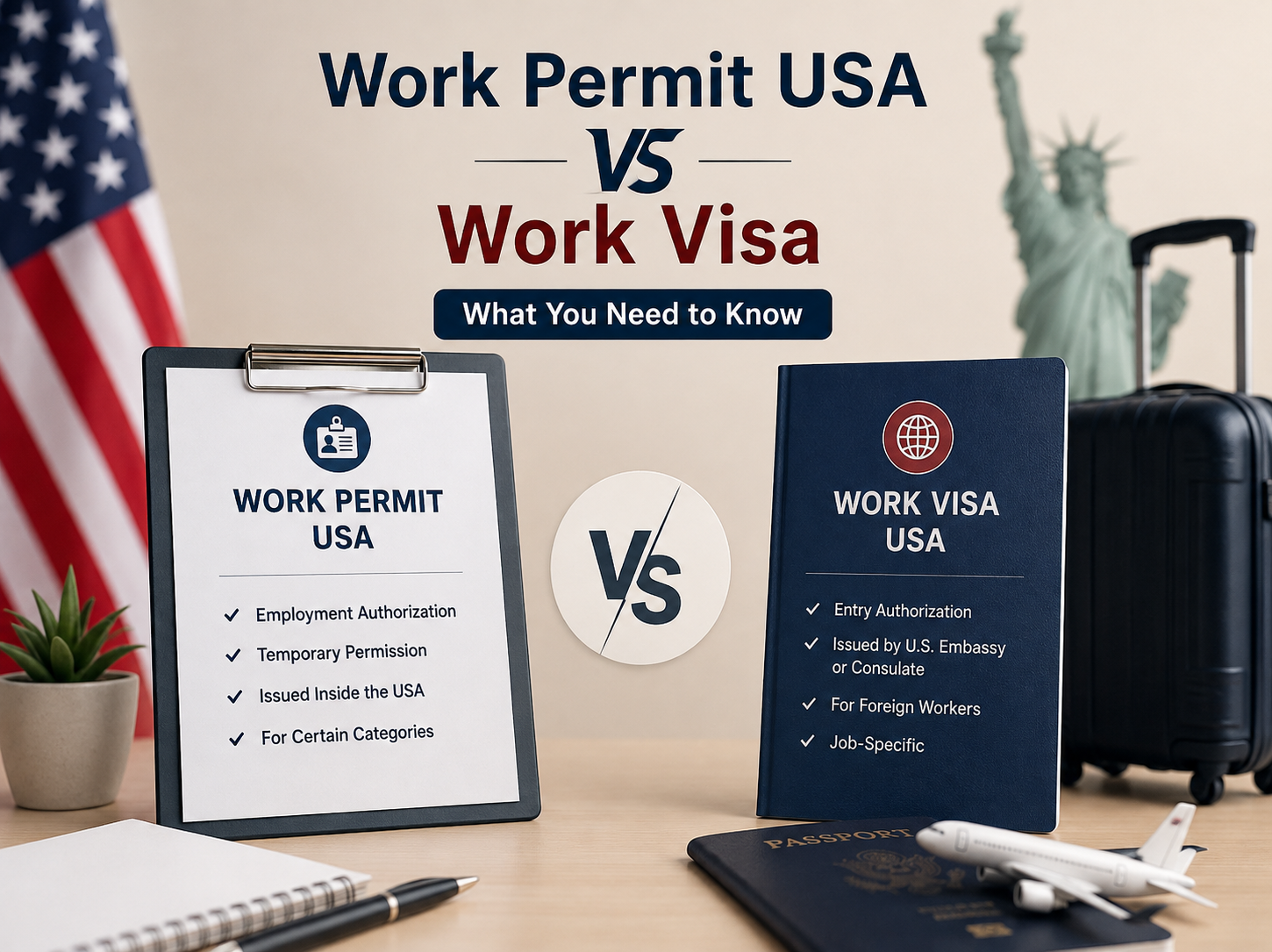
If you plan to work in the United States, understanding the difference between a work permit USA applicants may use and a work visa is an important first step. These terms are often used interchangeably, but they can refer to different immigration documents and employment permissions.
A work permit is commonly associated with an Employment Authorization Document (EAD), which can provide eligible noncitizens with authorization to work in the United States. A work visa, on the other hand, is generally connected to a specific immigration category that allows an eligible foreign worker to enter the United States for employment under defined conditions.
Knowing which option applies to your situation can help you avoid submitting the wrong application, preparing unnecessary documents, or accepting employment without proper authorization.
What Is a Work Permit in the USA?
A U.S. work permit generally refers to an Employment Authorization Document, commonly called an EAD. It is issued by U.S. Citizenship and Immigration Services to certain eligible individuals who are permitted to work in the United States.
Eligibility for employment authorization depends on the person's immigration category and circumstances. For example, some applicants may qualify for employment authorization because of a pending immigration application, a particular nonimmigrant status, or another qualifying category.
An EAD can serve as evidence that its holder is authorized to work during the period covered by the document. However, not everyone who wants to work in America can simply apply for an EAD. The applicant must generally have a qualifying basis for employment authorization.
What Is a Work Visa?
A work visa is an immigration visa category designed for certain foreign nationals who want to work in the United States. The appropriate visa depends on the type of employment, qualifications, employer, and immigration category.
The U.S. Department of State explains that temporary workers must qualify for the appropriate visa category based on their intended employment. Several employment-related categories exist, including H-1B, H-2A, H-2B, L, O, P, and Q classifications.
Many temporary employment visa categories require a U.S. employer or other qualifying petitioner to complete an immigration petition before the worker applies for the visa. For many petition-based categories, USCIS must approve the petition before the visa application can proceed.
Work Permit vs. Work Visa: The Main Difference
The easiest way to understand the distinction is to consider what each document does.
A work permit generally provides employment authorization to an eligible person who already has a qualifying immigration basis.
A work visa is generally connected to the person's ability to seek admission to the United States for a particular employment purpose under a specific visa classification.
In simple terms, an EAD answers an important question: “Am I authorized to work?”
A work visa addresses a different question: “What immigration category allows me to come to the United States for this employment purpose?”
The exact rules depend on the individual's immigration status and circumstances, so applicants should determine their eligibility before choosing an application route.
Common U.S. Employment Visa Categories
There is no single “work visa” that covers every type of employment. Different categories are designed for different situations.
For example, the H-1B category is generally associated with specialty occupations. H-2A covers certain temporary agricultural workers, while H-2B is used for certain temporary non-agricultural workers. Other categories apply to intracompany transferees, individuals with extraordinary ability, certain athletes and entertainers, and participants in approved exchange programs.
Choosing the correct category is important because each classification can have its own eligibility requirements, petition procedures, documentation, and employment limitations.
Who May Need an Employment Authorization Document?
Not every foreign national who works in the United States needs a separate EAD. Some immigration classifications authorize employment based on the person's status or admission.
Other eligible individuals may need to apply for employment authorization separately. The correct process depends on the immigration category and the reason the applicant qualifies for employment authorization.
Before filing, applicants should identify their current immigration status, determine whether they qualify for employment authorization, and review the requirements for their particular category.
Documents You May Need
The documents required for employment-related immigration applications vary according to the category. Depending on the situation, applicants may need items such as:
- A valid passport or identity document
- Immigration status documentation
- Employment or job-offer information
- Immigration forms and supporting evidence
- Previous immigration notices
- Proof supporting eligibility
- Photographs or other required application materials
For temporary worker visas, applicants may also need information connected to an approved petition. The Department of State notes that applicants can be required to provide items such as a passport, DS-160 confirmation, fee receipt when applicable, photograph, and petition receipt information.
Because requirements vary, applicants should always check the instructions that apply to their specific immigration category.
How to Choose the Right Employment Path
Start by identifying where you are in the immigration process.
If you are already in the United States and believe you qualify for employment authorization through your immigration category, you may need to explore an EAD-based route.
If you are outside the United States and have a U.S. employer offering qualifying temporary employment, you may need an employment-based visa process. Some temporary worker categories require an employer petition before the worker can apply for a visa.
The Department of State also provides a Visa Wizard that helps users identify potential visa categories based on their travel purpose and intended activities.
Common Mistakes to Avoid
One common mistake is assuming that having a U.S. visa automatically means a person can work. Visa eligibility and employment authorization depend on the applicable immigration category.
Another mistake is choosing an employment category based only on the job title. Immigration classifications have specific requirements, so the nature of the job, qualifications, employer, and circumstances may all matter.
Applicants should also avoid relying on outdated forms, unofficial instructions, or advice intended for a different immigration category. Requirements can change, so using current government information is essential.
What Happens After Approval?
The next step depends on the type of authorization or visa involved.
For a temporary employment visa, an approved petition does not necessarily guarantee visa issuance. The applicant still needs to complete the applicable visa process, and a consular officer makes the final visa decision.
For employment authorization, the individual should review the authorization document carefully and understand its validity period and any conditions associated with the underlying immigration status.
It is also important to maintain lawful immigration status and follow the employment restrictions associated with the relevant category.
Final Thoughts
Understanding the difference between a work permit USA applicants may obtain and a work visa can make the employment immigration process much easier to navigate. A work permit, often referring to an EAD, can provide employment authorization to eligible individuals, while a work visa generally relates to an immigration classification that permits qualifying foreign workers to seek entry for employment.
The correct option depends on your immigration status, intended employment, employer, qualifications, and overall circumstances. Taking time to identify the correct category before preparing an application can help reduce avoidable mistakes and delays.
If you are unsure whether you need employment authorization, a temporary worker visa, or another immigration category, review the current requirements from the appropriate U.S. government agency and consider qualified professional guidance for case-specific questions.

 Arabic
 French
 Spanish
 Portuguese
 Deutsch
 Turkish
 Dutch
Dutch
 Italiano
 Russian
 Romaian
 Portuguese (Brazil)
 Greek
Greek