
In the fast-paced world of American finance, the margin for error in financial reporting is zero. For the CFOs, Controllers, and Finance Directors steering large U.S. enterprises, the challenge is twofold: they must automate the cumbersome, manual processes that slow down the close, while simultaneously ensuring unshakeable compliance with a complex web of regulations like US GAAP, SEC rules, and SOX. The solution lies in centralization. By consolidating financial data from disparate operational systems into a single, authoritative source, organizations can transform their entire accounting function. This is the core value proposition of the Oracle Financial Accounting Hub (FAH) . Whether it's the on-premises version or the cloud-native Oracle Fusion Accounting Hub, U.S. enterprises are choosing this platform to gain a decisive edge, achieving a level of accounting automation and regulatory compliance that fragmented systems simply cannot match .
The Problem with Financial Fragmentation
Before understanding why enterprises choose FAH, it's essential to appreciate the chaos it resolves. Many large organizations operate a complex tapestry of specialized systems. A global investment firm may manage millions of revenue transactions in spreadsheets; a life sciences company might have subsidiaries running on different ERPs like SAP and legacy platforms; and a retailer could process sales through a custom-built e-commerce engine . When these systems aren't connected by a central accounting brain, the finance team faces a recurring nightmare:
-
Manual, Error-Prone Processes: Data is exported, manipulated in spreadsheets, and manually entered into the general ledger, a process fraught with risk and consuming thousands of hours .
-
Delayed Close Cycles: Reconciling data from multiple sources drags the financial close out for days or even weeks, starving leadership of timely insights.
-
Inconsistent Accounting: Without a central rulebook, different business units may apply accounting policies inconsistently, leading to compliance headaches and unreliable reports.
-
Audit Trail Blindness: Tracing a summarized number in a financial statement back to its original transaction becomes a forensic investigation, complicating audits and increasing risk .
Oracle Financial Accounting Hub is purpose-built to eliminate this fragmentation by creating a centralized, intelligent subledger engine .
The Architecture of Automation
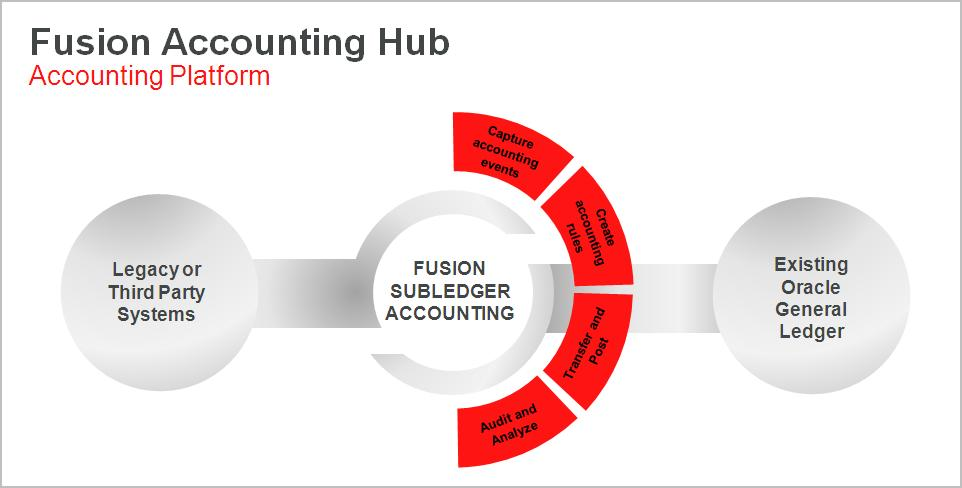
The power of FAH lies in its ability to decouple accounting logic from the operational systems where transactions originate . It acts as a universal translator and rule enforcer. Here’s how it automates accounting at scale:
-
Centralized Ingestion: FAH receives raw, transactional data from virtually any source—be it Oracle ERP, SAP, a custom billing app, or a claims system .
-
Intelligent Rule Application: At the heart of the system is the Subledger Accounting (SLA) framework. Finance teams define a centralized "rulebook" that dictates how every type of transaction should be treated. When data arrives, FAH automatically applies these rules to generate accurate, fully attributed journal entries .
-
Automated Distribution: These standardized entries are then seamlessly posted to the general ledger, providing a clean, audit-ready record of all financial activity .
This architecture transforms the finance function. For a global investment firm, it meant replacing millions of manually loaded spreadsheet transactions with automated feeds, dramatically reducing risk and accelerating reporting . For a life sciences company, it enabled the processing of data from SAP and legacy systems into GAAP-reportable entries under multiple standards without manual intervention .
Why Compliance is Inherent to the Design
For U.S. enterprises, compliance is not a feature—it's the price of entry. Oracle FAH is engineered to meet this demand by embedding compliance directly into the financial data lifecycle.
-
Multi-GAAP, Multi-Currency Mastery: One of the most complex compliance challenges is reporting under different accounting standards. A single transaction must often be represented differently for US GAAP, IFRS, and local statutory requirements. Oracle FAH excels here, allowing one transaction to generate parallel accounting entries across multiple frameworks, ensuring every legal entity is compliant . A global commodity trading company, for example, used FAH to build a strategic platform capable of handling multi-GAAP, multi-currency, and multi-chart of account requirements across more than 70 countries .
-
Unshakeable Audit Trail ("The Thrill of the Drill"): Perhaps the most celebrated feature among auditors is FAH's drill-down capability. With a single click, users can trace a balance in a general ledger account back through the subledger to the original source transaction . Oracle's own finance team, managing a $40 billion business, leveraged its Accounting Hub to gain this level of transparency, eliminating 90 redundant ledgers and immediately shaving a day off its close cycle . For the U.S. Department of Veterans Affairs or a defense contractor, this level of traceability is non-negotiable for maintaining federal compliance.
-
Centralized Control: By governing a single chart of accounts and a unified rulebook, enterprises can enforce consistent accounting policies across the entire organization. This prevents the "drift" that occurs when disparate systems are managed in silos, ensuring financial integrity from the top down .
Real-World Results: The Strategic Impact on U.S. Business
The decision to adopt Oracle FAH is validated by tangible results across various U.S. industries, moving companies from reactive, manual processes to a state of proactive, data-driven governance.
Case Study 1: AIPSO's Insurance Transformation
AIPSO, a non-profit service provider in the U.S. insurance ecosystem, was burdened by a fragmented financial landscape with disconnected systems for accounting, planning, and procurement. This led to manual reconciliations and a heavy regulatory reporting burden. By implementing Oracle Fusion Accounting Hub alongside ERP and EPM clouds, they achieved a 30% reduction in financial close time and a 40% decrease in manual effort. The solution provided 100% audit readiness and a real-time, single source of truth, enabling them to meet state-specific compliance mandates with ease .
Case Study 2: Life Sciences Multi-GAAP Efficiency
A market-leading life sciences company struggled with subsidiaries running on different ERP platforms, creating fragmented information and patchwork compliance. Oracle AHCS was implemented to process transactional data from these disparate systems and map it into GAAP-reportable journal entries. The outcome was a dramatic improvement in auditability, minimized close cycles, and scalable, accurate accounting across all geographies .
Case Study 3: The Oracle Finance Team's Own Transformation
Perhaps the most compelling endorsement comes from Oracle itself. Facing 32 different charts of accounts, the finance team deployed an Accounting Hub on Oracle Cloud ERP. In just nine months, they unified their financial data into a single source of truth, eliminated 90 redundant ledgers, and immediately reduced their financial close time by one full day. The team now enjoys "better control and transparency in the ledger close cycle," with the ability to drill down from the general ledger to subledger transactions .
Conclusion
For U.S. enterprises, the path to financial excellence is paved with automation and control. Oracle Financial Accounting Hub provides the definitive platform for this journey. It automates the mundane, enforces the complex, and illuminates the obscure. By centralizing disparate data and applying a consistent, intelligent rulebook, it empowers finance teams to close faster, report with confidence, and meet the highest standards of regulatory compliance. Whether it's an insurance firm achieving 100% audit readiness or a global manufacturer unifying its global ledgers, the choice is clear: Oracle FAH is the strategic foundation for modern, automated, and compliant finance operations in the United States.

 Arabic
 French
 Spanish
 Portuguese
 Deutsch
 Turkish
 Dutch
Dutch
 Italiano
 Russian
 Romaian
 Portuguese (Brazil)
 Greek
Greek