
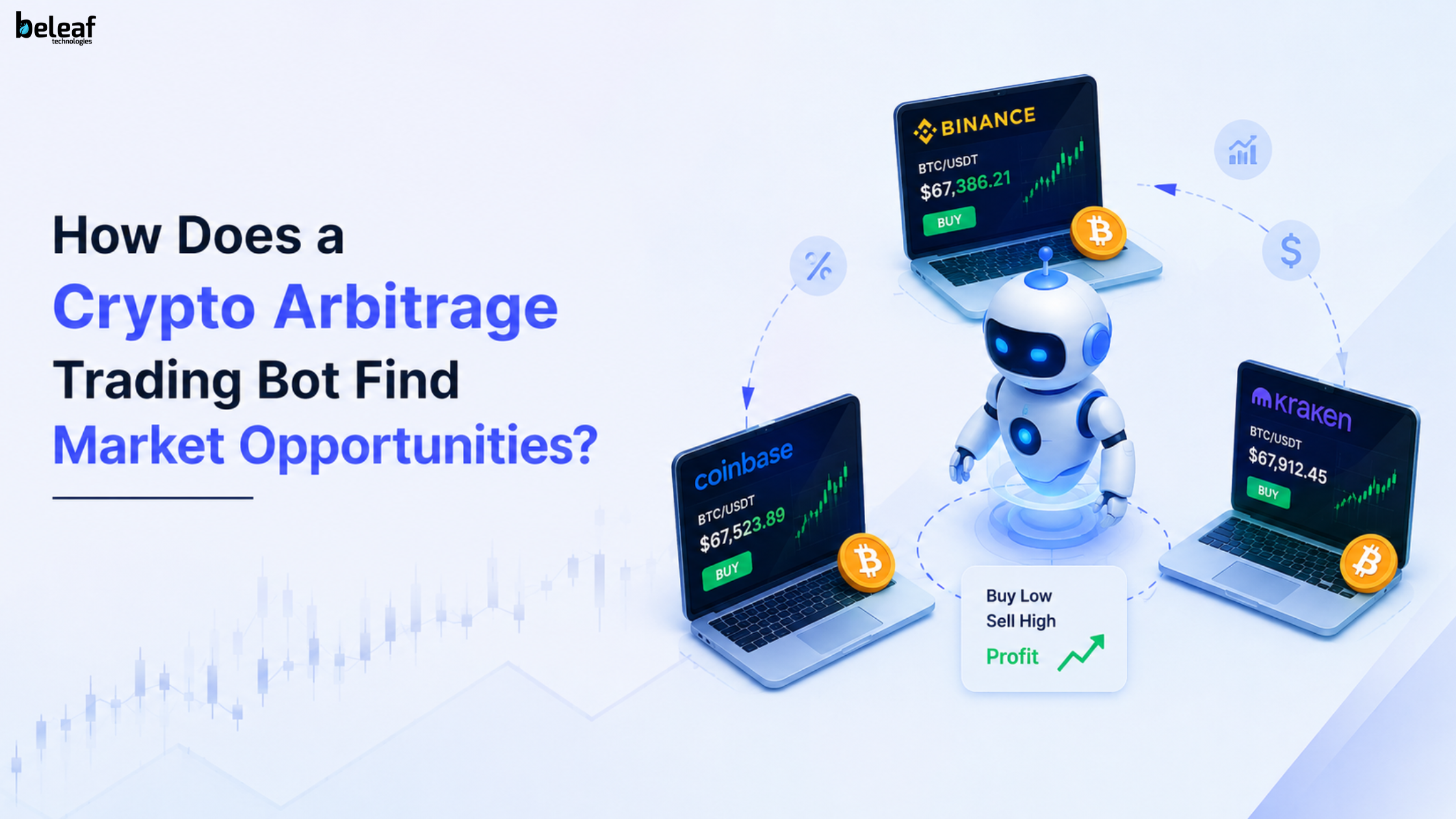
The market never stops moving. The entrepreneurs who profit from it are the ones who never stop watching it — automatically.
Most business owners look at the crypto market and see chaos. Experienced entrepreneurs look at the same market and see patterns — price gaps opening and closing between exchanges, inefficiencies appearing and disappearing in fractions of a second, opportunities that exist whether the market is rising, falling, or moving sideways.
Crypto Arbitrage Trading Bot Development is the discipline of building systems that catch those patterns before any human eye could spot them. This guide explains exactly how that process works — and why it represents one of the most reliable automated income models available to startup founders and business builders in 2025.
1. Watching Every Market at Once — The Power of Simultaneous Price Scanning
The foundation of any arbitrage strategy is simple: the same asset rarely costs exactly the same on two different exchanges at the same time. Bitcoin priced at $67,200 on one platform and $67,340 on another is not a coincidence — it is a structural feature of how independent markets work. Each exchange has its own pool of buyers and sellers, its own order flow, and its own price discovery process.
A professional arbitrage bot watches all of these markets at once, continuously comparing prices across dozens of exchanges without ever pausing or losing focus.
What that real-time scanning actually covers:
✅ Live price feeds from 10 to 50+ exchanges running through simultaneous API connections
✅ Hundreds of active trading pairs — BTC/USDT, ETH/BTC, SOL/USDT — monitored without gaps
✅ Bid and ask price comparisons refreshed on every incoming data tick
✅ Automatic flagging of any spread that clears the minimum profitability threshold
✅ Dynamic watchlist updates that shift focus as liquidity moves across pairs and platforms
What most people miss is that the opportunity is not in finding one big gap — it is in finding hundreds of small ones consistently, all day, every day. That consistency is what makes this a business rather than a gamble.
2. Three Ways a Bot Finds Gaps Other Systems Miss
Price gaps do not come in one shape. A well-engineered system built through Crypto Arbitrage Trading Bot Development runs multiple detection strategies in parallel — because relying on a single method means leaving a significant percentage of available opportunities on the table.
The three strategies that power professional opportunity detection:
◆ Cross-Exchange Arbitrage — The bot spots the same asset trading cheaper on one exchange and more expensive on another. It buys on the lower side and sells on the higher side simultaneously, pocketing the spread. Clean, direct, and the most frequently occurring opportunity type across the market.
◆ Triangular Arbitrage — Inside a single exchange, the bot identifies pricing imbalances between three connected trading pairs. A cycle like USDT to BTC, BTC to ETH, and ETH back to USDT may return more than the starting amount if the three pairs are temporarily misaligned. The bot completes the full cycle in one motion and captures the difference.
◆ Statistical Arbitrage — This approach goes beyond live prices. The bot tracks historical relationships between correlated assets and identifies moments when those relationships diverge from their normal range. When the relationship corrects — which it reliably does — the bot has already positioned itself to profit from that correction.
3. Reading Deeper Than Price — What Order Book Analysis Reveals
A price quote is a snapshot. An order book is a story. Smart Crypto Arbitrage Trading Bot Development goes beyond surface-level price comparison and pulls real-time order book data from every target exchange — because knowing the price means nothing if there is not enough volume sitting there to fill your trade at that price.
The five layers every order book read pulls out:
→ Bid depth — The total buy-side volume available at or near the current market price
→ Ask depth — The total sell-side volume available to absorb an incoming purchase
→ Spread width — The exact gap between the top buy offer and the lowest sell offer right now
→ Volume clusters — Where the largest order concentrations sit and how they shape short-term price movement
→ Side imbalance — When one side of the book significantly outweighs the other, price movement is often seconds away
This analysis does two things for the business operator. First, it confirms that a detected opportunity actually has the liquidity to execute cleanly. Second, it helps the bot avoid partial fills — situations where only part of an order executes, leaving an unhedged position that can quickly turn a projected profit into an actual loss.
4. The Pre-Trade Profit Gate — Nothing Fires Without Confirmation
Finding a gap is step one. Verifying that the gap is actually worth trading is where professional Crypto Arbitrage Trading Bot Development earns its value. Every opportunity that passes the detection stage immediately runs through an automated profit calculation before a single order is placed.
Every number that gets checked before execution:
-
Trading fees on both the buy side and the sell side of the transaction
-
Slippage estimate based on how deep the current order book actually is
-
Transfer and withdrawal costs if assets need to move between two exchanges
-
Blockchain network fees when on-chain movement is involved
-
Net profit floor — the trade only fires if the confirmed margin clears this minimum
This gate is not optional in a serious operation. Without it, a bot that looks profitable on paper quietly loses money after fees are applied to every trade. With it, every execution that goes live is already mathematically confirmed as a net positive — regardless of market conditions at that moment.
5. Execution Speed — The Edge You Cannot See But Always Feel
Two bots can detect the exact same opportunity at the exact same moment. The one that executes first captures the profit. The one that fires 300 milliseconds later arrives at a market that has already moved. In arbitrage, speed is not a nice-to-have feature — it is the product itself.
The infrastructure layers that separate fast bots from the ones that miss:
🔒 WebSocket data feeds that deliver price updates the instant they happen — not on a polling schedule
🔒 Servers positioned close to exchange infrastructure to cut physical data travel time
🔒 Pre-loaded order templates that remove all setup steps at the moment of execution
🔒 Parallel processing that checks multiple pairs and strategies at exactly the same time
🔒 Backup data connections that activate automatically if the primary feed experiences any lag
Every millisecond saved between detection and execution is a direct contribution to the business's bottom line. This is exactly why Crypto Arbitrage Trading Bot Development that prioritizes infrastructure quality pays for itself faster than any other platform investment.
6. Risk Filters — The Layer That Protects Every Trade
Speed without judgement is dangerous. A bot that fires on every detected gap without qualifying each one will inevitably execute on opportunities that look valid on the surface but carry hidden risks underneath. The risk filter layer is what gives professional Crypto Arbitrage Trading Bot Development platforms their consistency — by keeping the bot out of bad trades as reliably as it keeps it in good ones.
The five filters running between detection and execution:
⚠ Volatility Gate — Any opportunity identified during an abnormal price spike gets rejected. Spikes reverse fast, and a trade entered at the peak of one rarely exits cleanly
⚠ Liquidity Floor — If the order book on either side does not have enough depth to fill the position without moving the price, the opportunity is skipped entirely
⚠ Spread Decay Timer — If the detected spread narrows below the profit threshold in the time between detection and execution, the order is cancelled before it fires
⚠ Correlation Validator — On statistical trades, the bot re-checks the underlying asset correlation is still intact before committing any capital to the position
⚠ Position Conflict Lock — Prevents two simultaneous strategies from opening opposing positions on the same asset at the same time
These filters are not limitations on what the bot can do — they are the architecture that makes what it does profitable over the long run. Volume of trades means nothing without quality of trades behind it.
7. Getting Smarter Every Day — The Self-Improvement Engine
A static bot is a declining bot. Markets shift. Exchange fee structures change. Competitor infrastructure gets faster. The pairs that generated strong returns six months ago may be significantly more competitive today. The best arbitrage operations are built to recognize this and adapt without requiring manual intervention every time conditions evolve.
The continuous improvement cycle every advanced platform runs:
★ Records every executed trade — entry price, spread at detection, total fees, and net profit after all costs
★ Analyses which pairs and exchanges are generating the strongest consistent results and increases their weighting
★ Identifies pairs that are consistently underperforming and reduces or removes them from active scanning automatically
★ Re-calibrates minimum spread thresholds based on rolling volatility data across the past 30 to 90 days
★ Produces structured weekly performance summaries that give operators a clear picture of exactly where profit is coming from
Clear signals that your strategy needs a recalibration:
◉ Net profit per trade has declined more than 15% against your 30-day rolling average
◉ A single exchange is responsible for more than 65% of your total captured volume
◉ Execution success rate has fallen below 85% without any infrastructure changes on your end
◉ Newer high-volume trading pairs are consistently outperforming your existing primary watchlist
◉ You are regularly noticing that opportunities are closing a fraction of a second before your bot reaches them
The right Crypto Arbitrage Trading Bot Development foundation is built to absorb and respond to every one of these signals — not as an emergency fix, but as a routine part of how the system keeps itself sharp.
Two Lines That Capture What This Is Really About
A crypto arbitrage trading bot does not wait for the right moment — it builds the infrastructure to be ready for every moment, across every market, around the clock.
From the first price scan to the final profit confirmation, the entire system is designed to find what the human eye is too slow to catch and act on it before the window closes.
Conclusion — The Market Has Always Had Opportunities. Now You Have the System to Find Them.
Every price gap covered in this guide is already happening in the market right now. Somewhere between two exchanges, a spread is open that a well-built bot would detect, validate, and execute on in under 100 milliseconds. The question for every entrepreneur and startup founder reading this is not whether those opportunities exist — it is whether you have a system positioned to reach them.
The businesses generating consistent automated returns from arbitrage today did not get there by waiting. They built early, validated their infrastructure, refined their strategy through real performance data, and compounded their results over time. That path is fully available to any founder willing to take the first step seriously.
Every element a market-ready arbitrage business needs:
✔ Simultaneous price scanning across multiple exchanges through live WebSocket data feeds
✔ Three parallel detection strategies capturing cross-exchange, triangular, and statistical opportunities
✔ Order book depth analysis that validates liquidity before every single execution
✔ Pre-trade profit confirmation that accounts for every fee before an order goes live
✔ Low-latency infrastructure built to execute faster than the competition at every opportunity
✔ Intelligent risk filters that protect the capital base by keeping the bot out of bad trades
✔ A self-learning performance engine that makes the operation smarter with every completed cycle
The window to enter this market with a well-built, professionally engineered platform is open right now — and the entrepreneurs who move with clarity and the right partner will establish the strongest positions.
A professional Crypto Arbitrage Trading Bot Development Company will take your business from the initial concept through to a fully market-ready platform — built for detection precision, execution speed, capital protection, and the kind of scalability that grows with your ambitions rather than fighting against them.
The opportunities are in the market every single day. The only thing that determines whether you capture them is whether your bot is built well enough to find them first.
Frequently Asked Questions (FAQs)
Q1. How does a crypto arbitrage trading bot detect price differences across exchanges so fast?
The bot maintains live connections to multiple exchange APIs simultaneously through WebSocket feeds — which push price data the instant it changes rather than waiting for the bot to check. The moment a spread opens between two platforms that clears the net profit threshold after fees, the system flags it and begins the execution sequence. This happens in milliseconds. No human monitoring setup comes close to that response time, which is exactly why automation is the only practical approach to capturing these opportunities at scale.
Q2. Is one arbitrage strategy better than the others for a new business?
Each strategy has its strengths depending on the operational setup. Cross-exchange arbitrage tends to produce the most frequent opportunities and is the most straightforward to execute reliably. Triangular arbitrage works entirely within a single exchange, which removes transfer time and blockchain costs from the equation. Statistical arbitrage is slower but works across a wider range of market conditions. Most successful operations run two or three strategies simultaneously so that when one type of opportunity is quiet, the others are still generating activity.
Q3. What stops the bot from executing trades that look profitable but are not after fees?
The pre-trade calculation engine runs automatically on every detected opportunity before any order is placed. It pulls in the exact fee rates for both sides of the trade, models slippage based on current order book depth, adds transfer and network costs where applicable, and compares the total against the operator's minimum profit threshold. If the confirmed net margin does not clear that floor, the trade is rejected entirely. This is one of the most critical features in any professional platform and the reason well-built bots maintain their profitability consistently over time.
Q4. Does the bot need to run continuously or can it operate on a schedule?
Continuous operation is strongly advisable. Some of the most consistent arbitrage windows appear during off-peak trading hours when volume is lower and price discrepancies between exchanges take longer to close naturally. A bot that goes offline during those periods misses a meaningful portion of its total available opportunity. Running continuously around the clock is one of the core advantages of automated arbitrage over manual trading — it captures what human attention would inevitably miss.
Q5. How many exchanges is the right number to start with?
Starting with five to ten exchanges that offer strong API reliability, deep liquidity on the target pairs, and a clear fee structure gives a new operation everything it needs to generate consistent results. Adding more exchanges before the core infrastructure is validated tends to introduce complexity without proportional reward. Once the system is stable and performing as expected, expanding coverage incrementally is a natural and low-risk growth path.
Q6. What causes a bot to miss an opportunity it already detected?
The most common cause is execution latency — the time between detection and order placement is long enough for the spread to close before the trade fires. Other causes include order book depth being insufficient to fill the full position at the detected price, and network delays between the bot's server and the exchange's matching engine. Professional platforms address all three through proximity hosting, order book depth validation before execution, and spread-decay timers that automatically discard any opportunity that narrows below the profit threshold before the trade can land.
Q7. Can a startup with limited capital build a competitive bot business?
Yes — and the subscription model is exactly why. Rather than relying solely on personal capital to generate returns, a subscription-based arbitrage platform allows external participants to allocate their own capital to the system. The operator earns a percentage of profits generated on that capital, creating a revenue stream that scales with the user base rather than with the founder's personal reserves. Many of the most successful arbitrage businesses running today were built on this model from the very beginning and scaled their capital position progressively through reinvestment rather than large upfront funding.

 English
 Arabic
 French
 Portuguese
 Deutsch
 Turkish
 Dutch
Dutch
 Italiano
 Russian
 Romaian
 Portuguese (Brazil)
 Greek
Greek