
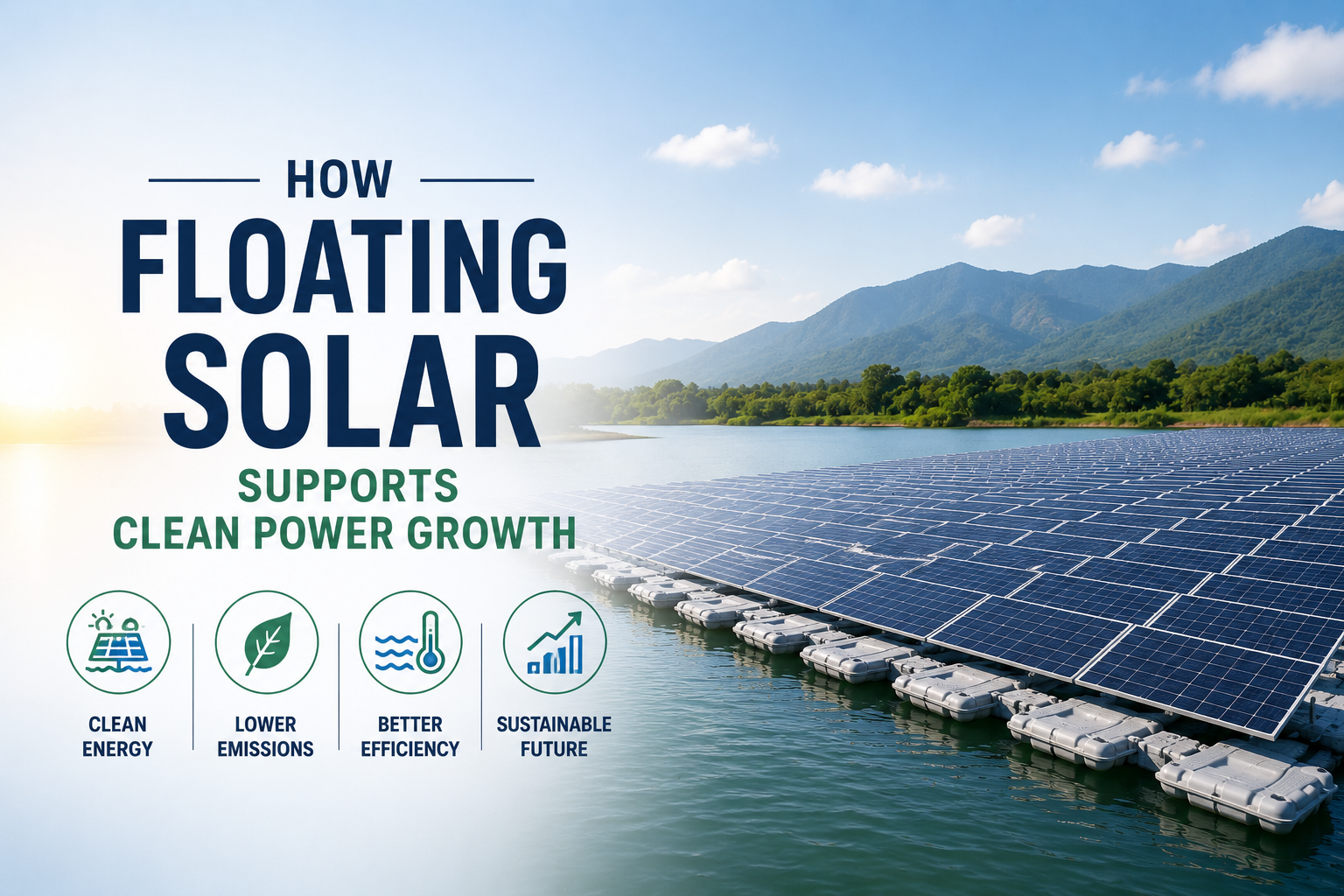
Floating solar is becoming an important renewable energy option as countries look for ways to expand solar power without depending only on land-based projects. These systems place photovoltaic panels on floating structures over reservoirs, lakes, ponds, quarry sites, irrigation basins, and selected marine areas. Their value comes from producing clean electricity while using water surfaces that may otherwise have limited energy use.
A recent global floating solar study by MarkNtel Advisors highlights strong demand from medium-scale projects, marine waterbody installations, Asia-Pacific deployment, and rising clean-energy investment. The report values the sector at USD 16.98 billion in 2025 and projects it to grow from USD 18.29 billion in 2026 to USD 42.66 billion by 2032, reflecting a CAGR of around 15.2% during 2026–2032.
Land Constraints Support Adoption
Floating solar is useful in regions where land is expensive, crowded, agriculturally important, or difficult to acquire for large solar parks. By using water surfaces, project developers can reduce pressure on land while still adding solar generation capacity. This is especially relevant in densely populated countries and industrial regions with rising electricity demand.
The World Bank’s floating solar assessment notes that floating solar can offer advantages such as higher energy yield, reduced evaporation, and improved water quality compared with some land-based systems. These benefits explain why utilities and governments are increasingly evaluating reservoirs and other water bodies for solar deployment.
Medium-Scale Projects Lead Demand
Projects between 10.1 MW and 50 MW accounted for nearly 42% share in 2026, according to the shared study. This size range is practical because it offers meaningful power output while remaining easier to design, finance, install, and connect than very large floating solar plants. It suits reservoirs, industrial water bodies, and utility-linked sites.
Medium-scale projects can also serve local grids, industrial facilities, water utilities, or hybrid energy systems. Their development depends on site depth, water-level variation, anchoring design, wind conditions, grid access, permits, and environmental assessment. Proper planning is important because floating systems face different engineering conditions than ground-mounted solar farms.
Marine Waterbody Installations Are Rising
Marine waterbody installations accounted for nearly 55% share in 2026, making them the leading waterbody category in the report. Marine and nearshore floating solar projects may use coastal zones, sheltered waters, ports, lagoons, and other managed environments where solar deployment can be combined with existing infrastructure.
Marine installations require careful technical design because saltwater, waves, corrosion, storms, tides, and anchoring loads can create harsh operating conditions. Materials, cables, floats, mooring systems, and maintenance practices must be selected for durability. Strong engineering standards become essential where floating solar is exposed to more demanding water conditions.
Asia-Pacific Holds the Largest Share
Asia-Pacific accounted for nearly 44% share in 2026, according to the report. The region’s leadership is supported by high electricity demand, solar manufacturing strength, land constraints, large reservoir networks, and active renewable energy policies in countries such as China, India, Japan, South Korea, Indonesia, Thailand, and Vietnam.
The region also includes island and coastal economies where water-based solar can help diversify power supply. As solar demand increases, floating systems may complement rooftop solar, ground-mounted parks, hydropower reservoirs, and industrial energy projects. This makes Asia-Pacific a central region for floating solar deployment and technical learning.
Hydropower Reservoirs Offer Synergies
Floating solar can pair well with hydropower reservoirs because existing transmission lines, substations, and power infrastructure may already be available. Solar output during daylight hours can complement hydropower operations, while hydropower can support flexibility when solar generation changes. This can improve renewable energy use at existing energy sites.
The World Bank’s floating solar executive summary highlights advantages such as using existing transmission infrastructure at hydropower sites and proximity to demand centers. These factors can reduce some development barriers when compared with greenfield land projects.
Solar Expansion Creates Wider Opportunity
Floating solar benefits from the broader global expansion of solar photovoltaics. As module costs, inverter technology, monitoring tools, and installation practices improve, floating applications can use many of the same power-generation components while adapting structures and anchoring systems for water environments.
The International Energy Agency’s solar PV tracking shows how solar PV has become a major part of renewable electricity growth. This wider momentum supports floating solar because developers, investors, and utilities are already familiar with solar technology, grid integration, and project financing.
Environmental Assessment Remains Important
Floating solar can reduce land use and may reduce water evaporation, but projects still require environmental review. Shading water surfaces can affect light penetration, temperature, oxygen levels, aquatic ecosystems, fisheries, recreation, and reservoir management. Impacts depend on system size, coverage ratio, waterbody type, and local ecology.
Responsible development requires site-specific studies, stakeholder consultation, safe electrical design, and monitoring after installation. Developers should avoid assuming that every waterbody is suitable. Projects on drinking-water reservoirs, protected ecosystems, or community-use lakes may require stricter safeguards and public engagement.
Maintenance Needs Differ from Land Projects
Floating solar maintenance includes cleaning panels, inspecting floats, checking anchors, monitoring cables, managing corrosion, and ensuring safe access for technicians. Water-level changes, storms, biofouling, and wave movement can affect equipment performance. These conditions make operations and maintenance planning important from the design stage.
Access systems, boats, walkways, sensors, and remote monitoring tools can improve maintenance efficiency. In marine environments, corrosion protection and cable integrity become especially important. Reliable maintenance helps protect energy output and reduces downtime over the project life.
Outlook for Floating Solar
Floating solar demand is being shaped by land constraints, medium-scale projects, marine installations, Asia-Pacific leadership, hydropower reservoir opportunities, and wider solar PV growth. The report figures indicate strong expansion through 2032 as developers use water surfaces to add renewable generation capacity.
The long-term direction will depend on permitting, anchoring technology, environmental safeguards, financing, grid access, material durability, and project economics. As countries continue expanding clean electricity supply, floating solar is likely to become a practical complement to rooftop and land-based solar systems.

 English
 Arabic
 French
 Spanish
 Portuguese
 Deutsch
 Turkish
 Dutch
Dutch
 Italiano
 Romaian
 Portuguese (Brazil)
 Greek
Greek