
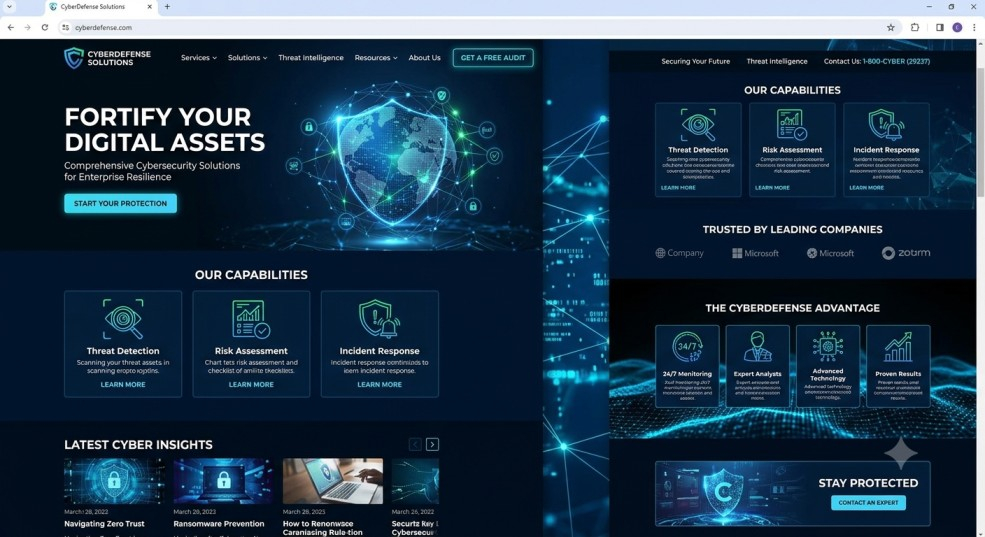
“Unpatched CVE with a CVSS score of 8.6 affecting your externally facing infrastructure” means something very specific to a security professional. To a business owner, it can mean almost nothing- just a string of intimidating technical language attached to a problem they now have to evaluate and prioritize without understanding what it actually means for their business. That gap between technical accuracy and genuine understanding is exactly where many valuable security findings get lost. A Cyber Security Website Template can help present technical findings in simpler language, explaining the business impact, urgency, and recommended actions so non-technical decision-makers can understand what needs attention.
A cyber security website template built to explain security gaps in plain language helps that translation happen properly, so clients actually understand and act on what you've found, instead of just nodding along at a report they can't fully interpret.
Why Explaining Gaps Clearly Matters More Than General Service Descriptions
Service descriptions get read before a client commits to working with you. Gap explanations get read after you've already found something concerning, at a moment when clear understanding directly affects whether they take appropriate action.
Clients Need to Understand Findings to Act on Them
A technically accurate but incomprehensible explanation of a security gap doesn't help a client prioritize fixing it. If they don't understand the actual risk, they can't make an informed decision about urgency or resources.
Poor Communication Can Undermine Trust in Your Findings
If a client can't understand what you're telling them, they may either dismiss the finding as unimportant or feel like they're being oversold on something they don't have the context to evaluate, either of which damages the relationship.
Translating Technical Findings Into Plain Language
Explaining What the Gap Actually Means in Practice
Rather than technical descriptions alone, explaining what a specific vulnerability actually allows, what an attacker could realistically do because of it, helps clients understand practical consequences rather than abstract technical detail.
Connecting Findings to Business Impact
Framing a gap in terms of business consequence, potential data exposure, financial risk, and operational disruption helps clients understand why a technical issue matters to them specifically, not just to a security professional's checklist.
Avoiding Unnecessary Technical Detail in Initial Explanations
Leading with plain-language explanation, and offering full technical detail as a secondary, optional layer, respects that most clients need to understand impact and priority far more than technical specifics.
Structuring Gap Explanations for Clarity
Starting With Severity in Plain Terms
Leading with an accessible severity indicator, "this is a serious risk that should be addressed soon" versus dense technical scoring, helps clients immediately grasp urgency without needing to interpret a numerical scale themselves.
Explaining the Gap in a Single Clear Sentence
Providing one plain-language sentence summarizing each finding, before any additional detail, ensures the core message comes through even if a client doesn't read further.
Using Consistent Structure Across All Findings
Applying the same explanation format, what it is, why it matters, what to do, across every identified gap helps clients quickly learn how to interpret your reports as they review multiple findings.
Using Analogies to Explain Technical Vulnerabilities
Comparing Vulnerabilities to Physical Security Concepts
Comparing a technical gap to a more familiar physical security concept, an unlocked door, a broken lock, a window left open, helps non-technical clients intuitively grasp the nature of a risk they can't directly observe themselves.
Relating Findings to Everyday Business Risks
Framing security gaps alongside more familiar business risk concepts, like an uninsured liability or an unaddressed safety hazard, helps clients categorize the issue using risk frameworks they already understand.
Making Priority and Urgency Clear Without Jargon
Using Simple, Consistent Priority Labels
Clear labels like "urgent," "important," and "worth addressing eventually," rather than technical severity scores alone, help clients quickly triage multiple findings without needing to interpret a scoring methodology.
Explaining Why Something Is Urgent in Concrete Terms
Rather than simply labeling something urgent, briefly explaining the concrete reason, "this could be exploited without any special access" or "attackers commonly target this exact type of gap", reinforces the priority level with genuine understanding.
Addressing What Happens If a Gap Isn't Addressed
Briefly noting realistic potential consequences of inaction helps clients understand genuine stakes without requiring technical background to interpret abstract risk descriptions.
Visual Features That Support Jargon-Free Explanation
Simple Risk Level Indicators
Visual indicators, color-coded or icon-based, representing risk severity help clients quickly scan and prioritize multiple findings without reading extensive technical descriptions for each one.
Diagrams Illustrating How a Gap Could Be Exploited
Simple visual walkthroughs showing, in accessible terms, how a specific vulnerability could realistically be used against a business help make abstract technical risk feel more concrete and understandable.
Before-and-After Visuals for Recommended Fixes
Where applicable, visuals showing the difference between a vulnerable state and a properly secured one help clients understand exactly what a recommended fix actually changes.
Read More: Best Cyber Security WordPress Themes for Modern Businesses
Supporting Deeper Technical Understanding When Needed
Offering Full Technical Detail as an Optional Layer
For clients with internal IT staff who want complete technical specifications, providing this detail through expandable sections or separate technical appendices serves that need without cluttering the primary, accessible explanation.
Providing a Glossary for Any Necessary Technical Terms
When certain technical terms genuinely can't be avoided, a simple glossary or inline definitions help bridge understanding without requiring extensive prior knowledge.
Building Trust Through Honest, Accessible Communication
Avoiding Both Oversimplification and Unnecessary Alarm
Explaining gaps honestly and accurately, without either dumbing down the genuine risk or exaggerating it for dramatic effect, maintains credibility and helps clients trust your assessment of their actual situation.
Demonstrating Expertise Through Clarity, Not Complexity
Explaining complex security concepts clearly actually demonstrates deeper expertise than relying on jargon, since genuine understanding of a topic usually includes the ability to explain it accessibly.
Making Gap Explanations Actionable
Clearly Stating Recommended Next Steps
Following each explanation with a clear, specific recommendation, rather than leaving clients to figure out appropriate action on their own, turns understanding into genuine forward movement.
Explaining Realistic Remediation Timelines
Providing general guidance on how quickly a particular gap should reasonably be addressed helps clients prioritize appropriately among multiple identified issues.
Mobile Presentation of Gap Explanations
Since clients may review findings or reports from their phones between other responsibilities, ensuring plain-language explanations, visual indicators, and priority labels display clearly on mobile keeps this critical communication genuinely accessible.
Conclusion
Explaining security gaps without unnecessary technical jargon isn't about diluting the seriousness of genuine findings, it's about making sure clients actually understand and can act on what you've discovered. Through plain-language summaries, relatable analogies, and clear priority framing, a well-built cybersecurity website template helps bridge the gap between technical accuracy and genuine client understanding. This kind of clarity-focused communication is exactly what you'll find supported in premium WordPress Themes designed for cyber security professionals, helping your findings actually lead to meaningful action instead of confused nodding.
Frequently Asked Questions
1. Should technical severity scores be removed entirely from client-facing gap explanations?
Not necessarily removed, but leading with plain-language severity descriptions and offering technical scores as secondary detail respects that most clients need accessible framing first.
2. Are analogies really effective for explaining technical vulnerabilities to non-technical clients?
Yes, comparing unfamiliar technical concepts to relatable, everyday ideas helps clients intuitively grasp risks they can't directly observe or technically understand themselves.
3. Does explaining gaps in plain language reduce the perceived seriousness of genuine findings?
No, clear explanation actually reinforces seriousness by ensuring clients genuinely understand real consequences, rather than dismissing a finding they couldn't interpret in the first place.
4. Should full technical detail still be available for clients with internal IT staff?
Yes, offering this depth through expandable sections or separate technical appendices serves that audience without cluttering the primary, accessible explanation for non-technical readers.
5. How can gap explanations be made more actionable rather than just informative?
Following each explanation with a clear, specific recommended next step and realistic remediation timeline helps turn understanding into genuine forward movement rather than just informational reading.

 English
 Arabic
 French
 Spanish
 Portuguese
 Deutsch
 Turkish
 Dutch
Dutch
 Italiano
 Russian
 Romaian
 Greek
Greek